Adjustable vs Fixed Appliance Stands – Which One Is Better for Pakistani Homes?

Published By
Shakeel Ahmed
Updated On
July 2, 2026
Buying a stand for your fridge or washing machine sounds simple — until you stand in front of two options and realise they behave very differently once a heavy appliance is sitting on top.
The movable-and-adjustable vs fixed appliance stand decision affects how stable your machine is, how easily you can clean behind it, how long the stand lasts, and whether it still fits when you upgrade your appliance two years from now.
This guide breaks down both types honestly — where each one wins, where each one fails, and which makes more sense for a modern home built to a higher standard.
A fixed appliance stand is cheaper and fine if your floor is perfectly level, you never plan to change your appliance size, and you don’t mind dragging the machine out by hand to clean behind it.
A movable, height-adjustable appliance stand costs a little more but solves three problems that quietly wreck most setups — uneven floors, appliances that don’t come in standard sizes, and the impossible-to-clean gap behind a heavy machine.
For most homes, movable and adjustable is the smarter long-term buy.
What Is a Fixed Appliance Stand?
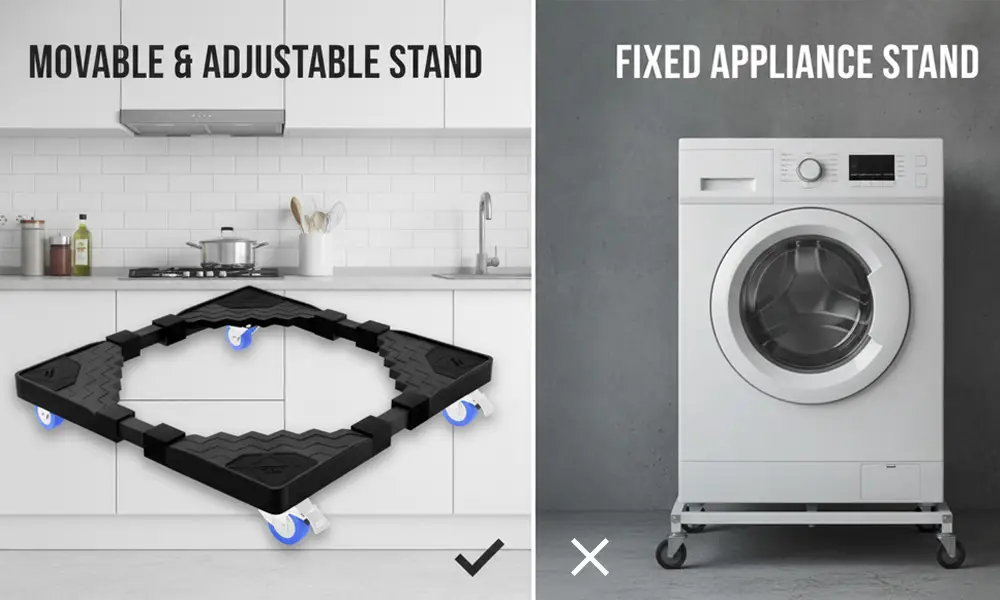
A fixed appliance stand is a one-size frame welded or moulded to a set height and width, with no wheels. You place your appliance on top, and that’s it — nothing moves, including the appliance.
Most of the budget stands on the market fall into this category: plastic “chowki” bases, fibre platforms, and basic light mild-steel frames.
Where fixed stands work w ell:
- Your floor is genuinely level — properly finished and tiled.
- Your appliance matches the stand’s dimensions closely.
- You rarely need to access the floor or wall behind the appliance.
- You want the cheapest possible option for a short-term or temporary setup.
Where fixed stands fall short:
- If the floor dips even slightly, the appliance rocks — and there’s no way to correct it.
- The cheap plastic versions crack or sag under a fully loaded fridge or a washing machine on spin.
- Cleaning behind the appliance means dragging a heavy machine across the floor — risking scratched tiles and a strained back.
- When you replace your appliance with a different-sized model, the stand is often useless and gets thrown away.
In short, a fixed stand assumes a perfect world: a flat floor, an appliance that never changes, and a gap behind it you never need to reach. That’s rarely the reality.
What Is a Movable & Adjustable Appliance Stand?
A movable, adjustable appliance stand does two jobs at once. It lets you adjust the height and width to match your specific appliance and your specific floor, and it lets you move the whole setup on lockable wheels when you need to.
The adjustability solves an engineering problem most people don’t notice until it’s too late:
appliances rarely come in standard sizes, but most stands do. That mismatch is what causes instability, vibration, and uneven weight distribution. An adjustable frame closes that gap by fitting the appliance precisely instead of forcing the appliance to fit the stand.
The mobility solves a practical, everyday problem: the floor and wall behind a heavy fridge or washing machine are nearly impossible to reach. With lockable caster wheels, you simply roll the appliance out, clean behind it, and roll it back — then lock the wheels so it sits rock-solid in use.
A well-built movable, height-adjustable stand should include:
- A reinforced MS steel frame that carries a heavy fridge or washing machine without flexing.
- A locking adjustment mechanism so the frame stays rock-solid after you set the size.
- Lockable caster wheels — they roll smoothly when unlocked, then grip firmly in place when locked.
- Rubber anti-vibration pads to absorb the shake of a washing machine spin cycle and reduce noise.
- Elevation that improves airflow under the appliance — useful for refrigerator heat management and for keeping the base away from floor moisture.
The trade-off is a slightly higher price than a basic plastic base. But you’re paying for stability, mobility, durability, and the ability to keep the stand when your appliance changes.
Movable & Adjustable vs Fixed Appliance Stand: Side-by-Side Comparison
| Feature | Fixed Appliance Stand | Movable & Adjustable Appliance Stand |
| Fit | One set size — appliance must match | Adjusts to height & width of any appliance |
| Mobility | None — appliance is stuck in place | Lockable wheels roll out for cleaning & access |
| Uneven floors | No correction — appliance rocks | Levels out minor floor dips |
| Stability & vibration | Depends entirely on a perfect match | Tunable fit + locked wheels + rubber pads reduce shake |
| Cleaning access | Must drag the machine out by hand | Roll out, clean, roll back |
| Material (typical) | Often plastic / fibre / light MS | Reinforced MS steel, load-balanced frame |
| Load capacity | Lower; plastic can crack or sag | Higher; built for heavy appliances |
| Future appliance change | Usually needs replacing | Re-adjusts to the new appliance |
| Upfront price | Cheaper | Slightly higher |
| Long-term value | Lower (often replaced) | Higher (reused, lasts longer) |
The pattern is clear: fixed stands win on sticker price; movable, adjustable stands win on fit, mobility, stability, durability, and value over time.
Why the Stand Type Actually Matters
This isn’t just theory — a few everyday realities tilt the decision toward movable and adjustable.
Floors are rarely perfectly level. Many homes — especially older construction or homes finished in stages — have floors that aren’t truly flat. A fixed stand can’t do anything about this, so a heavy appliance ends up rocking on one corner. An adjustable frame lets you correct minor leveling issues without shoving folded cardboard under one leg.
The space behind the appliance is a dust and water trap. Lint behind a washing machine and dust behind a fridge build up fast, and a fixed stand makes that area unreachable. Lockable wheels let you roll the unit out in seconds, clean properly, and roll it back — no dragging, no scratched floor.
Appliances get changed often. Households upgrade brands and sizes regularly. A fixed stand built for one size becomes scrap when the new unit doesn’t fit. An adjustable stand simply re-sizes to the new appliance.
Washing machines vibrate hard. On the spin cycle, an automatic washing machine shakes aggressively. If the stand doesn’t grip the floor and the machine evenly, that vibration turns into noise, “walking,” and long-term wear. A snug adjustable fit, locked wheels, and rubber pads keep it steady.
Moisture and heat are real factors. Elevating the appliance improves airflow underneath, which helps refrigerator heat dissipate at the base and keeps the appliance off a damp floor — worth having in any humid season.
Cheap plastic doesn’t survive heavy loads. A lot of low-cost stands are light plastic or fibre. They look fine but flex, crack, or sag under a fully loaded fridge. Durability is exactly where a reinforced steel build earns its place.
Best Use Cases
Movable & Adjustable Washing Machine Stand
For automatic washing machines, a movable, adjustable washing machine stand is usually the better pick. The spin cycle demands a tight, even fit — and that’s precisely what an adjustable frame plus anti-vibration pads delivers. Lockable wheels let you roll the machine out to clear lint, check hoses, or mop up a leak, then lock it back into a stable position. You also get protection from floor water, which matters in a laundry area.
Movable & Adjustable Fridge Stand
A refrigerator is heavy and runs 24/7, so stability and airflow both count. A movable, adjustable fridge stand lets you set the exact footprint of your fridge, distribute the weight evenly, and lift the base off the floor for better ventilation. When the back of the fridge needs cleaning, you simply unlock the wheels and roll it out instead of straining to shift it. And when you eventually upgrade to a larger fridge, the same stand re-adjusts instead of going to waste.
Appliance Stand Buying Guide: How to Choose
Use this short appliance stand buying guide before you buy:
- Check your floor. If it’s perfectly level and you’re sure of it, a fixed stand can work. If there’s any doubt — and there usually is — go adjustable.
- Match the load to the material. For a heavy fridge or washing machine, choose reinforced MS steel over light plastic. Confirm the load rating.
- Look for lockable wheels, not just wheels. Mobility is only useful if the stand stays put under load. Make sure the casters lock firmly.
- Look for a real locking adjustment mechanism. Adjustability is only useful if the frame stays firmly fixed after you set it. No locking, no stability.
- Prioritise anti-vibration pads for any washing machine setup.
- Think two years ahead. If you’re likely to change the appliance, an adjustable stand pays for itself by not needing replacement.
- Don’t buy on price alone. A stand that cracks or rocks costs you more in the long run than one built to last.
Frequently Asked Questions
Is a movable, adjustable appliance stand worth the extra cost?
For most homes, yes. It corrects uneven floors, fits any appliance size, lets you roll the machine out to clean behind it, reduces vibration, and can be reused when you change appliances — so the higher upfront price usually works out cheaper over time.
Are the wheels stable enough to hold a heavy fridge or washing machine?
Yes, when they’re proper lockable casters. The wheels roll only when unlocked; once locked, they grip the floor and hold the appliance firmly in place — so the stand is movable when you need it and solid the rest of the time.
Can a fixed stand handle a heavy fridge or washing machine?
A sturdy steel fixed stand can, but many budget plastic and fibre stands flex or crack under heavy, constant load. Always check the material and load rating.
Does an adjustable stand really fix an uneven floor?
It corrects minor floor leveling issues and lets you set a stable, even footprint. For severely uneven floors, the floor itself should be addressed — but for the small dips common in most homes, an adjustable frame solves it.
Will one stand fit both my fridge and washing machine?
A good adjustable stand is designed to resize for different appliances, so the same model can typically be set for a refrigerator or a washing machine within its size and weight range. Check the specific range before buying.
Do these stands reduce washing machine noise?
A snug, level fit, locked wheels, and rubber anti-vibration pads noticeably reduce the shake and noise of a spin cycle compared to a loose or rocking setup.
The Bottom Line
In the movable-and-adjustable vs fixed appliance stand debate, a fixed stand makes sense only in a narrow case: a perfectly level floor, an appliance you’ll never change, and a gap behind it you never need to reach. For everyone else — which is most homes — a movable, adjustable appliance stand is the smarter buy. It fits any appliance, corrects uneven floors, rolls out for easy cleaning, holds heavy loads on a reinforced steel frame, cuts vibration, and stays useful long after your current fridge or washing machine is gone.
At StandsHub, our movable, height-adjustable stands are engineered around exactly these problems — reinforced MS steel, a load-balanced frame, a secure locking mechanism, lockable caster wheels, and anti-vibration pads — so your appliances sit stable, level, mobile, and protected for years.
Ready to upgrade? Browse our movable, adjustable appliance stands and pick the perfect fit for your fridge or washing machine — with fast delivery across Pakistan.
Shakeel Ahmed
The founder of StandsHub with 7+ years of experience in appliance stand and home utility solutions in Pakistan. He focuses on creating durable, practical designs that improve appliance stability, mobility, and everyday home convenience. Read More